

Learn / Spot versus perpetual futures
Derivatives
Spot versus perpetual futures
A spot trade exchanges one asset for another. A perpetual futures trade exchanges cash flows based on the price, and you never have to take delivery. The screens look similar. The thing you own is not.
What you hold
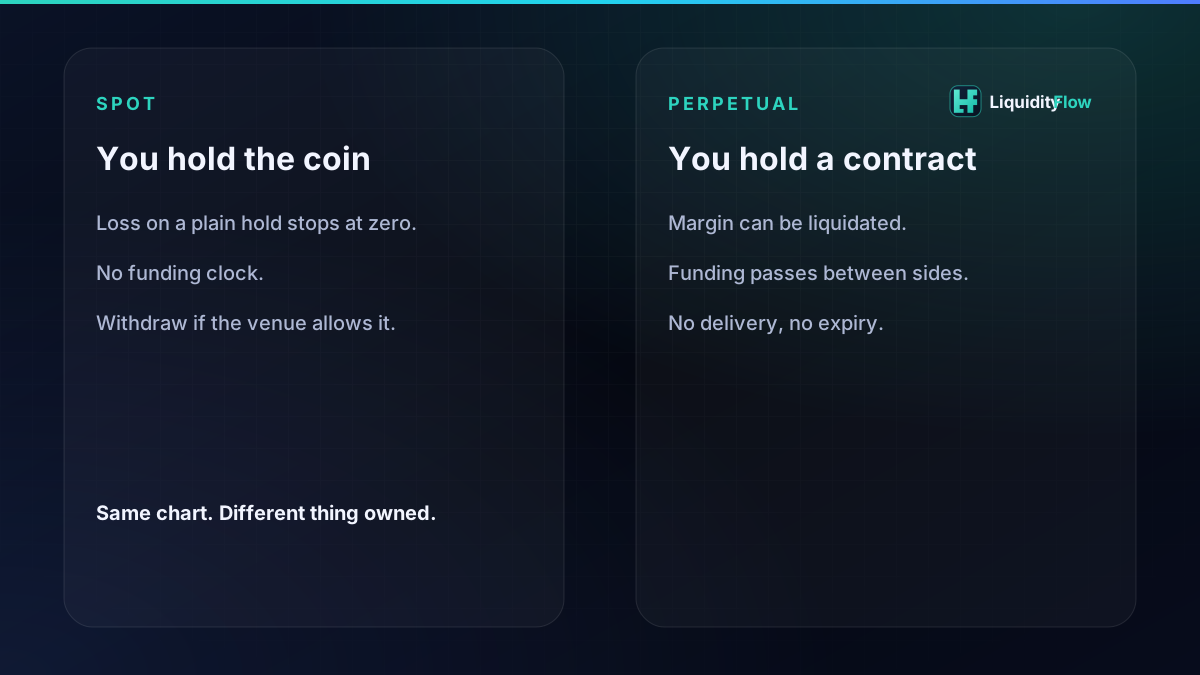
After a spot buy you have the coin, or a claim on the coin at the exchange. You can withdraw it if the venue and the network allow it. Your loss, if you simply hold, stops at zero. The coin can go to nothing. It cannot go through nothing and invoice you for more.
A perpetual position is a contract. Long means you gain when the mark rises and lose when it falls. Short is the reverse. The position is margined. If losses eat the margin, the venue liquidates the position and you can lose the margin in full. With leverage above 1× you can lose a large share of the margin on a small move.
Why the price is not exactly the spot price
Perpetuals do not expire, so they need a mechanism to stay near spot. That mechanism is the funding payment between longs and shorts. When the perp trades above the index, longs typically pay shorts. When it trades below, shorts typically pay longs.
You can be right on direction and still lose money if funding and fees cost more than the move. The funding article on this site walks through the payment. The fee article walks through maker and taker.
Which screen to use for learning
Use the coin page for the spot reference price, supply, and history. Use the fees desk to see what a round trip costs on a partner venue. Use the practice desk to sketch a leveraged position against the live price. The practice desk does not send an order.
One position, two products
Use case: you want exposure to a $1,000 move in Bitcoin. On spot, you buy the coin. A 10% decline takes the holding from $1,000 to $900 if that was the whole purchase, and nothing liquidates you. On a 10× isolated perpetual, $100 of margin controls about $1,000 of notional. A 10% decline against you consumes that margin. The price path that is a dip on spot is a liquidation on the contract.
The perpetual can also charge funding while you wait. Spot does not. If you only wanted the coin in a wallet, the contract is the wrong product even when the chart is the one you already understand.
Read the venue’s contract spec for the index, the mark, and the funding interval. Our FuturesHUB pages define those words. They do not pick a side.
Questions
Does a perpetual long mean I own the coin?
No. You own a margined contract that pays off based on the price. You do not receive the coin unless a specific product says you do.
Can a spot hold be liquidated?
A plain spot hold, with no borrow, is not liquidated. A margin or futures position can be.