FuturesHUB / Leverage
Perpetual futures
Leverage
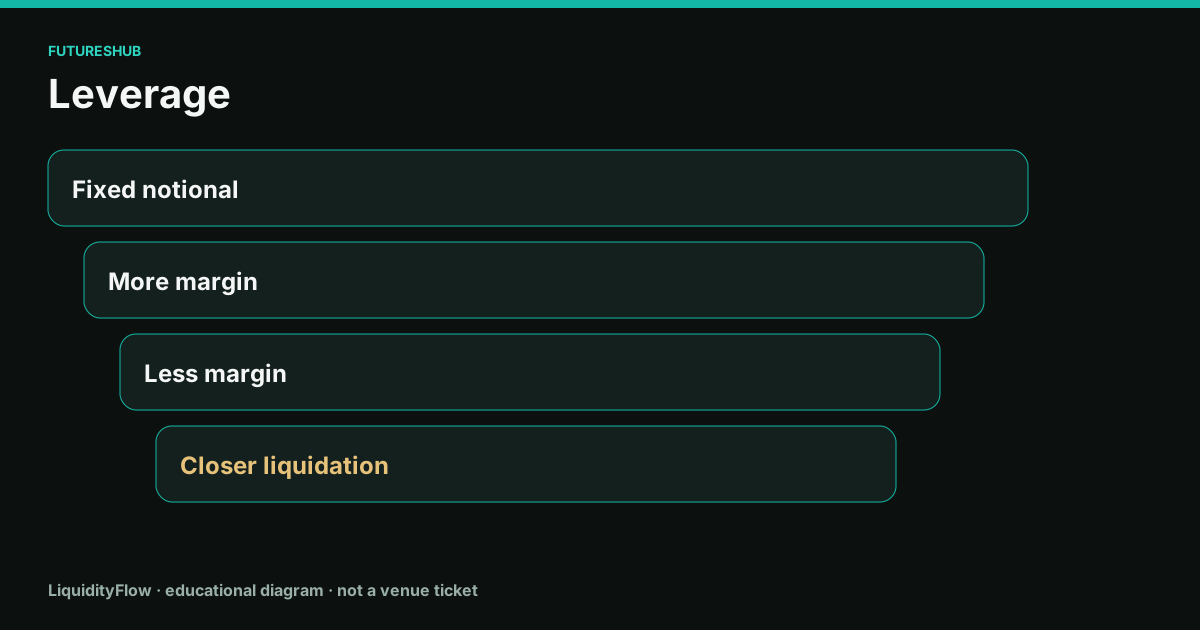
Leverage is a ratio. Pick the notional you want, and leverage tells you how little margin the venue will accept. The price move still applies to the whole notional.
Same exposure, different deposit
A linear position of $10,000 notional gains or loses about $100 when the mark moves 1%, at any leverage. At 5x you posted about $2,000, so the $100 is 5% of margin. At 25x you posted about $400, so the $100 is 25% of margin. The market did the same thing. The account experienced it differently because the deposit was thinner.
This is why a leverage slider is a dangerous size control. Dragging it from 5x to 25x without reducing quantity multiplies the sensitivity of the account and pulls liquidation closer. Dragging it while also letting the venue resize the order is a different action. Read whether the ticket keeps quantity fixed.
The liquidation distance shrinks
In the desk sketch, maintenance is 0.5% and a long liquidation level is entry times (1 minus 1/leverage plus 0.005). At 10x that is about 9.5% under the entry. At 25x it is about 4.5% under the entry. The short side mirrors this above the entry. The sketch caps the input at 50x, matching the practice desk.
A stop that sits beyond the liquidation price will never be the exit. The engine closes the position first. Place the stop, then read the liquidation price, and reduce leverage or size until the liquidation price is beyond the stop.
Caps are per tier and per contract
The leverage advertised on a market page is the maximum in the smallest tier, often only for the major contracts. A larger notional, an alt contract, or a stock-linked contract can have a lower cap. The ticket enforces the cap for the tier you are actually in.
Partner notes on this site record published maximums next to dated fees. Those maximums are descriptions of the venue page we copied. They are not a suggestion to use them. The tools workbook refuses inputs above 50x so the sketch stays in a range you can inspect.
On the ticket
- Write the notional and the dollar loss on a 1% move. Ignore leverage for that line.
- Choose leverage only after the stop exists. Confirm the sketched liquidation price is farther away than the stop.
- Read the ticket preview. Confirm quantity stayed where you set it when you moved the leverage control.
- If the contract's tier cap is below the leverage you wanted, reduce notional. Do not split the idea into a second account to dodge a tier.
Questions
Does 10x make a 1% move into a 10% price move?
The price move is still 1%. The profit is still about 1% of notional. That profit is about 10% of the margin you posted at 10x.
Why does the tools form stop at 50x?
The sketch is there to show the shape of liquidation distance. Capping the input at 50x matches the practice desk and keeps a teaching form away from the highest advertised caps.