FuturesHUB / Funding rate
Perpetual futures
Funding rate
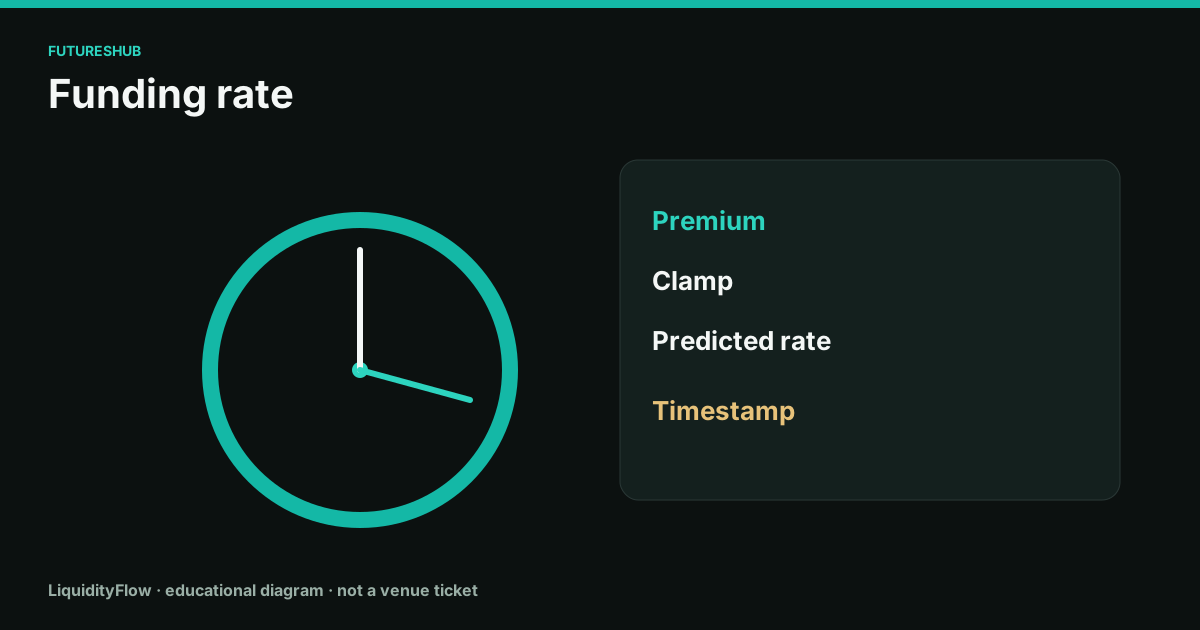
The funding rate is a percent applied to position notional at a scheduled time. Its job is to make the expensive side of the perpetual pay the cheap side, so the contract does not live far from spot forever.
The sign
On the usual specification, a positive funding rate means longs pay shorts. A negative rate means shorts pay longs. The size of the rate is the premium, smoothed and clamped, sometimes plus a small interest term. The contract page is the authority if a venue writes the sign the other way.
A positive rate is common in a market where traders prefer leveraged longs. It is a cost of holding that long, and it is income for the short who is willing to take the other side. It is not a forecast that the price will rise, and it is not a fee schedule.
Predicted versus realized
The ticket shows a predicted rate that updates during the window. The realized rate is fixed at the funding timestamp and applied to positions open at that instant. A prediction at lunch can be a different number at the timestamp.
Because the rate is a percent of notional, leverage does not multiply it a second time. A $20,000 notional pays the same funding at 5x and at 20x. The difference is that the payment is larger relative to the smaller margin.
What this desk will not invent
LiquidityFlow does not stream a live funding rate. The tools workbook asks you to type the percent you read on the venue, and it labels that number as your input. A default placeholder is an example of the unit, not a quote.
Caps, interest components, and the impact size differ by contract. Copy them from the specification when you need a number you might act on. The explanation here is the mechanism, published so you can read the ticket faster.
On the ticket
- Read the predicted rate and the time until the next timestamp on the venue.
- Multiply notional by the rate. A rate of 0.01% on $20,000 is $2 for that interval. Confirm the percent convention on the ticket. Some screens print 0.01 and mean 0.01%.
- Decide whether you will be open at the timestamp. Flat positions do not pay.
- Write the realized rate into the journal after it prints. Do not leave the morning prediction in the cost column.
Questions
Does positive funding mean the price will go up?
It means longs are paying shorts because the perpetual is rich to the index, on the usual specification. The next price move is a separate event.
Does higher leverage increase the funding payment?
The payment is a percent of notional. Higher leverage reduces the margin posted for that notional. It does not change the dollar payment unless you also change the size.