FuturesHUB / Order types
Perpetual futures
Order types
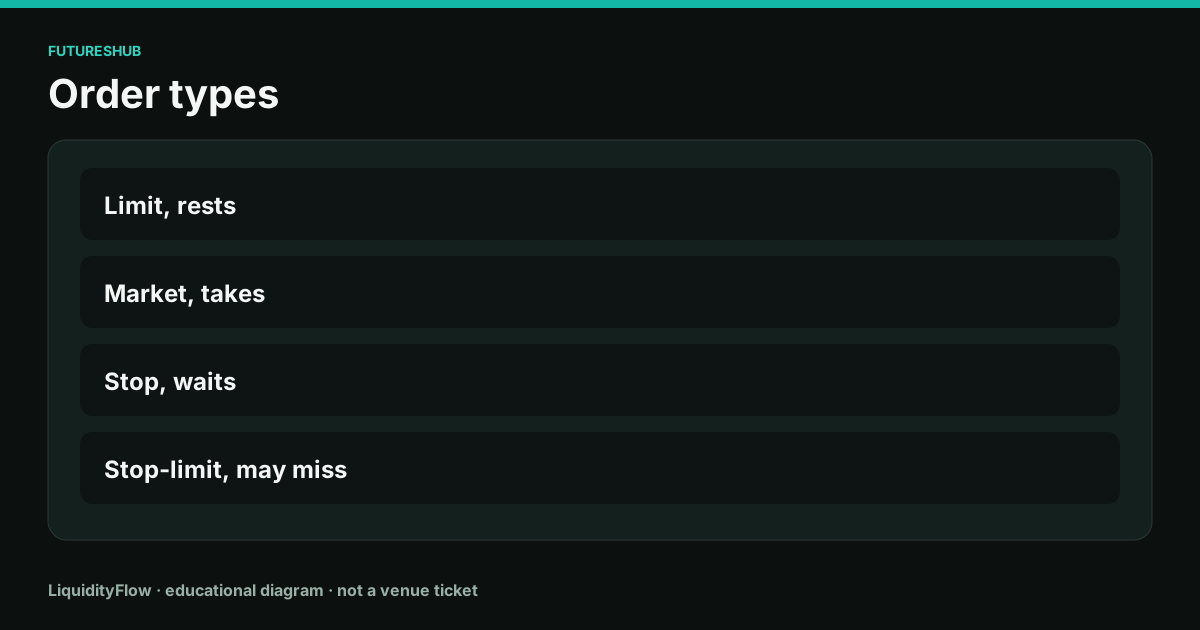
An order type is an instruction about time and price. Choosing it decides whether you pay the spread now, wait for your price, or wait for a trigger and then do one of those.
Limit and market
A limit order trades at your price or better, or it rests. If it rests, you are offering liquidity and you usually pay the maker fee when it fills. If it crosses the spread immediately, you are taking liquidity even though you typed a limit, and you pay the taker fee. The fee follows the role, not the button label.
A market order takes the other side now, walking the book for your whole size. You pay the taker fee and you pay slippage equal to the distance from the mid to the average fill. On a deep bitcoin book that distance can be small. On a thin contract it can be the largest cost in the trade.
Stop and stop-limit
A stop holds an instruction until the trigger price prints on the source you selected: last, mark, or index. A stop-market then sends a market order. A stop-limit sends a limit at a second price you chose. The trigger is not a fill.
A stop-market will almost certainly trade and can slip. A stop-limit might not trade at all if price gaps through the limit. Pick the failure you prefer: a worse price, or a position that is still open.
Flags that change the type
Post-only turns a crossing limit into a reject or a reprice, so you do not accidentally take. Reduce-only refuses to open or flip a position. Time in force decides whether a limit rests, fills immediately or cancels, or fills entirely or cancels.
Read the preview line that states maker or taker, the trigger source, and the flags. The preview is the order. The button name is advertising.
On the ticket
- For an entry you are willing to miss, use a limit and read whether the preview says maker.
- For an exit you are not willing to miss, use a stop-market and accept slippage, or stand at the screen with a market order.
- Set the trigger source explicitly. Write it in the journal next to the stop price.
- Turn on reduce-only for exits in one-way mode so a large stop cannot flip you.
Questions
Does a limit order always pay the maker fee?
Only if it rests and then fills as the passive side. A limit that crosses the spread pays the taker fee.
Is a stop a position?
No. A stop is a waiting instruction. You have no fill, no funding change, and no new margin use until it triggers and the resulting order trades. A resting stop can still reserve nothing, or reserve margin, depending on the venue. Read the available-balance effect.