FuturesHUB / How costs stack
Perpetual futures
How costs stack
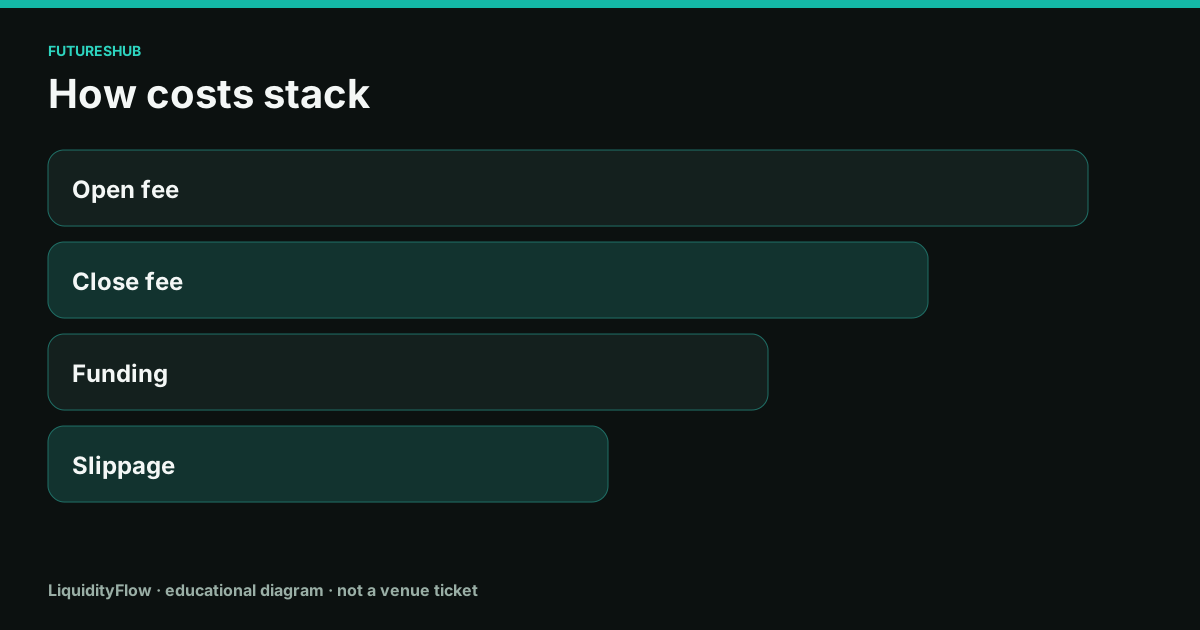
The number on a fee schedule is one layer. The position pays a stack: open, close, both slips, and every funding timestamp in between. Compare venues on the stack you will actually hold, not on the single rate in the headline.
Build the stack in order
Start with notional from the position-size page. Add the open fee from the role you will play. Add the entry slippage from the book. Add the close fee and the exit slippage, including a stop that may fill worse than the trigger. Add funding: the rate you read, times notional, times the number of intervals you intend to hold.
A $10,000 notional held for one eight-hour interval, taking liquidity both ways at 0.06%, slipping 0.05% each way, and paying 0.01% funding, costs $6 plus $6 in fees, $5 plus $5 in slippage, and $1 in funding. Twenty-three dollars. None of those lines replaces the others.
A low fee can lose the comparison
A schedule with a lower taker rate wins the fee line and can lose the stack if its book is wider or its funding is persistently paid by your side. The fee desk is there so the fee line is dated and visible. The tools page is there so you can type a funding rate and see that line too. The book on the venue is there so you can see the slippage line, which we do not invent.
Holding period dominates. A scalp that is open for seconds pays fees and slippage and usually misses funding. A swing that is open for a week pays funding many times and can dwarf a 0.02% difference in taker rate. Match the comparison to the hold.
The line you hope to skip
Liquidation replaces your planned exit with the engine's exit and adds a liquidation fee. If the stack you can afford assumes a calm stop fill, and the liquidation price is closer than that stop, the stack is fiction. Fix the distance first, then add the costs.
Write the stack before the trade and the realized stack after. The difference is how you learn which line you consistently underestimate. For most people it is slippage on the stop, or funding on a position they meant to hold for an hour and held for a day.
On the ticket
- Compute notional from dollar risk and stop distance on the tools page.
- Add a taker or maker round trip from a dated schedule. Leave it blank when the schedule is unverified.
- Type the funding rate you read on the venue, the interval count, and the days. Add that bill.
- Add an entry slip and an exit slip from the book. If the total stack is larger than the risk budget, the position does not fit. Reduce notional or skip the trade.
Questions
Which cost should I compare across exchanges?
The stack for the way you actually trade: your role, your hold time, and a slippage estimate from each book. A single taker rate is only the first line.
Does LiquidityFlow add the stack up for me?
The tools page computes risk-based notional, a funding bill from a rate you type, and a taker round trip from a dated schedule. You add your own slippage. The page does not send an order.