[Beginner] Liquidation on KCEX, step by step: it starts when the MARK price hits your level, and at 100x on BTC today that level sat 0.5% away
The most common beginner mistake with liquidation is thinking it happens when the price on the chart hits some number you worked out from your margin. On KCEX it is a bit different, and the differences are what decide whether you keep anything.
Real numbers first. At about 4:21 PM ET today, KCEX's BTC_USDT perpetual showed last 81,273.5, mark (fair) price 81,274.7, index 81,310.5, a 24h range of 81,051.5 to 82,032.7, and funding of 0.0075%. The contract spec lists max leverage 125x, a 0.5% maintenance margin rate on the first risk tier, maker 0% and taker 0.01%.
Take a 0.01 BTC long opened at 81,273.5 in isolated mode. Position value is 812.74 USDT. Maintenance margin is 812.74 x 0.005 = 4.06 USDT. Using KCEX's long formula, liquidation price = (maintenance margin - position margin + entry x quantity) / quantity, fees left out:
- 5x: margin 162.55, liquidation about 65,425.2, about 19.5% below mark
- 10x: margin 81.27, liquidation about 73,552.5, about 9.5% below
- 20x: margin 40.64, liquidation about 77,616.2, about 4.5% below
- 50x: margin 16.25, liquidation about 80,054.4, about 1.5% below
- 100x: margin 8.13, liquidation about 80,867.1, about 0.5% below
Today's whole 24h BTC range on KCEX was about 1.2%. At 100x, your liquidation level would have been under 200 points below that range's low. At 5x it is nowhere near.
What actually happens, in order
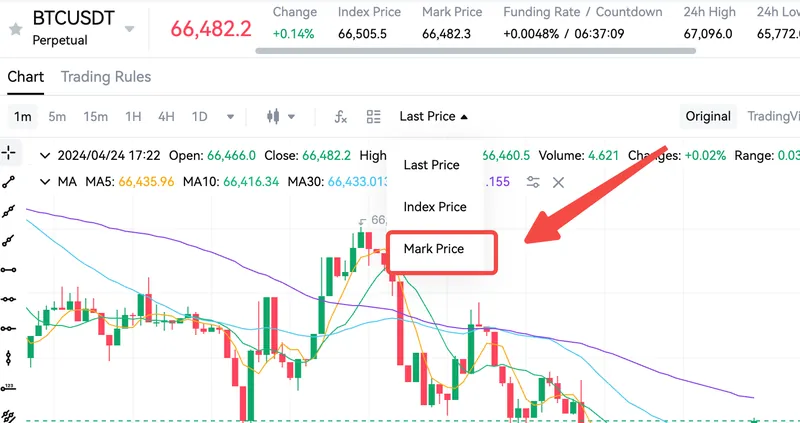
- The trigger is the mark price, not the last trade. KCEX liquidates when your margin ratio reaches 100%, and it measures that with the mark price, which it builds from the index, the order-book mid and the last price. The screenshot is from KCEX's own liquidation FAQ: it shows the BTCUSDT chart's price dropdown with Last Price, Index Price and Mark Price, and the arrow points at Mark Price. Switch your chart to it if you want to watch the line that actually matters.
- Your open orders get cancelled. In cross mode every open order on the account is cancelled first. In isolated mode that happens if auto margin addition is on. If the margin ratio is still 100% or more, it keeps going.
- Cross only: long/short self-dealing. If you hold both a long and a short in cross mode, KCEX nets them against each other to shrink the position.
- Step-down, then full takeover. If your position is big enough to sit above the first risk tier, part of it is taken over by the liquidation engine at the bankruptcy price to drop you a tier, and the check runs again. At the lowest tier, whatever is left is taken over at the bankruptcy price. For BTC the first tier covers 119,270 contracts at 0.0001 BTC each, about 11.93 BTC, so a 0.01 BTC beginner position goes straight to this last step.
Why you do not get the last 4 USDT back
For the 20x example, the bankruptcy price (where your margin is exactly zero) is about 77,209.8, roughly 406 points below the 77,616.2 liquidation price. That gap is your 4.06 USDT of maintenance margin. KCEX says that if the taken-over position can be closed in the market at a better price than bankruptcy, the remaining margin goes to the insurance fund. So in isolated mode, plan on losing the full 40.64 USDT, not 36.58.
Three things that move or break your liquidation level
- Funding. In isolated mode, if a funding payment is due and you have no spare available margin, KCEX takes it from the position margin, which pulls the liquidation price closer. At today's 0.0075%, that is about 0.06 USDT per settlement on this position, small but not zero. In cross mode every funding payment changes it.
- Cross margin. Cross uses your whole available balance, so the liquidation price shifts every time your other positions gain or lose.
- A stop-loss set too close. KCEX lists this as the first reason stops fail: if the stop is too near the liquidation price, liquidation can fire first. TP/SL orders on KCEX execute at market, so the fill can land past your trigger in a fast move.
Quick FAQ
Q: Does auto margin addition save me? It buys room, only in isolated mode. Each top-up is opening price x quantity x maintenance rate, here about 81,273.5 x 0.01 x 0.005 = 4.06 USDT, pulled from available balance. KCEX's own ETH example: a 5x long at 3,500 with an estimated liquidation of 3,300 and 80 USDT spare gets 40 USDT added, which moves liquidation to 3,250. When the spare balance runs out, it stops.
Q: Is the leverage I pick what sets the maintenance rate? No. KCEX sets it by position size through the position tiers. Leverage changes how much margin you post, which is why it moves liquidation so much in the table above.
Q: Same idea on other coins? Yes, but each contract has its own tiers. For scale, today's 24h ranges on KCEX were about 1.7% on ETH (2,376.87 to 2,416.66), 2.2% on SOL (102.99 to 105.23), 2.7% on XRP (1.2947 to 1.3301) and 3.3% on DOGE (0.07811 to 0.08065). A normal day's swing on DOGE was more than twice BTC's, so the leverage that feels safe on BTC is tighter on the others. Check each one's maintenance rate in Futures Information, then Position Tiers.
Open an account
 KCEX
Referral code
Open KCEXThe LiquidityFlow promo code for KCEX is T7HAJY. It is already attached to the registration link on this page. LiquidityFlow may earn a commission if you register through that link. Affiliate disclosure
More KCEX posts
- Zero fee isn't zero cost: the math on swapping 10,000 USDT to USDC on KCEX
- Sentiment at 51 as BTC 80,582.90 dips on KCEX - Senator probes Tether's reported $6 million payments to ex-White House crypto adviser's firm
- 31 KCEX perps, 5 movers, 3 headlines: the Friday evening rundown (BTC 81,138.00)
- When the insurance fund is not enough: how KCEX decides whose winning position gets auto-deleveraged (the ranking formula, explained)