
Election night, then the Fed: a 92% Democratic House price, a 49-50 CLARITY vote and a December hike debate, and what each means for crypto this week
Key takeaway
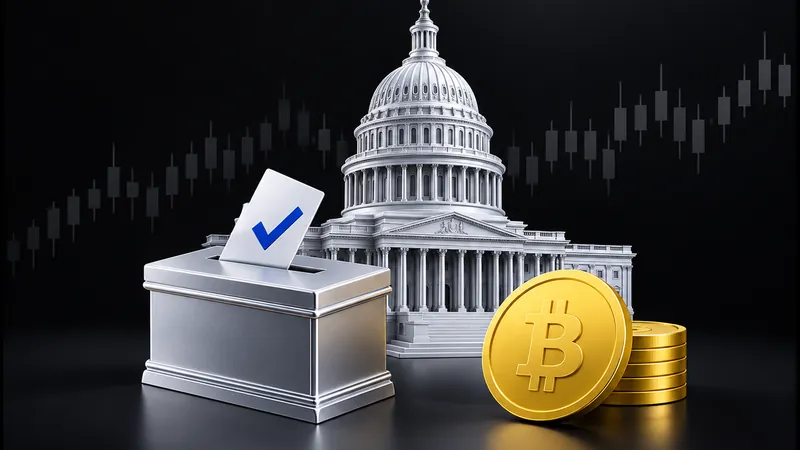
Tuesday's vote covers all 435 House seats, 35 Senate seats and 36 governorships, and crypto money has rarely tried harder to shape the result. BYDFi's Monday preview pulls together the odds, the spending and a Fed meeting that may end up mattering more than any single race.
The odds going in
Republicans hold a narrow House majority (218 seats are needed) and a 53-47 Senate, with Vice President Vance breaking ties. Democrats need a net gain of four Senate seats.
Prediction markets moved hard in the last days of October. By October 30, the two biggest priced a Democratic House at 92% and 94%, and a Democratic Senate at 69% on both. One nonpartisan forecaster puts 220 House seats in the leaning or solid Democratic column, two above the line, with 17 toss-ups, and rates the Senate itself a toss-up. One polling average has presidential approval at 34%, disapproval at 61%.
The Senate runs through seven states: Texas, Maine, Michigan, Alaska, Iowa, Ohio and Nebraska.
Timing risk for traders
Polls close in waves from 6 p.m. to 1 a.m. ET on Tuesday. That is 23:00 to 06:00 GMT, and 07:00 to 14:00 Beijing time on Wednesday, November 4, so the first real headlines land during Asian trading hours. House control may be clear overnight. The Senate may not be: mail-ballot postmark rules, signature curing and slow rural counts, Alaska in particular, could push certification toward mid-November and keep rate and equity volatility elevated while the count runs. Crypto trades through every one of those hours.
The money versus the voters
Crypto-linked political groups put about $176 million into more than 100 congressional races through October 20. The largest industry super PAC and its affiliates account for roughly $150.8 million of that, and it backed 32 House incumbents, 19 Republicans and 13 Democrats.
Voters do not share the priority. A May survey of 1,000 registered voters found that 1% named crypto a top issue. That gap cuts one way: lawmakers face little pressure from constituents if they decide to tighten the rules.
What the result changes, and what it does not
- Stablecoins: the GENIUS Act is already law, so federal issuance, reserve and supervision standards stay in place whoever wins.
- Market structure: the CLARITY Act passed the House 294-134 in July 2025, but a Senate motion to proceed failed 49-50 on September 15. A revival in the next Congress needs a fresh bipartisan deal, and at least one custody-bank executive expects tighter rules for DeFi and for firms that combine exchange, brokerage, custody and market-making under one roof.
- Oversight: a Democratic House hands every committee gavel, and subpoena power, to the other party. Investigations touching crypto ventures linked to the president's family are widely expected.
- Split result: more investigative friction in the House, and market-structure compromises that narrow toward compliance and illicit-finance guardrails.
One rumor to file under unconfirmed: chatter about a MetaMask token has revived alongside the DeFi rules debate. There is no official announcement.
The bigger driver may be December 8-9
Expectations for a Fed hike at the December 8-9 meeting have been building. Higher short-term rates lift two-year and ten-year Treasury yields and raise the discount rate applied to long-duration and non-yielding assets, a group that includes $BTC.USDT and $ETH.USDT. A divided Congress makes large deficit-funded packages in 2027 less likely, which could temper long-end term premiums and leave front-end yields to the Fed. A hawkish Fed also tends to support the dollar and tighten dollar funding abroad.
So a sharp move in $SOL.USDT, $XRP.USDT or $DOGE.USDT on Wednesday morning is not automatically an election verdict. Check whether yields moved first.
A short plan for the week
- Mark the 6 p.m. to 1 a.m. ET window and settle position size before it opens, not during it.
- Expect the Senate to drag. Do not size for a single overnight resolution.
- Separate settled law (GENIUS) from open questions (CLARITY, DeFi rules) when reading headlines.
- Watch the two-year yield alongside the race calls.
- Once certification is done, shift attention to the data feeding the December meeting.
The vote decides who writes the next set of crypto rules. The Fed decides what money costs while they write them.
Open an account
BYDFiBYDFi fees, review and signup details
Open BYDFiLiquidityFlow may earn a commission if you register through that link. Affiliate disclosure