FuturesHUB / What a perpetual is
Perpetual futures
What a perpetual is
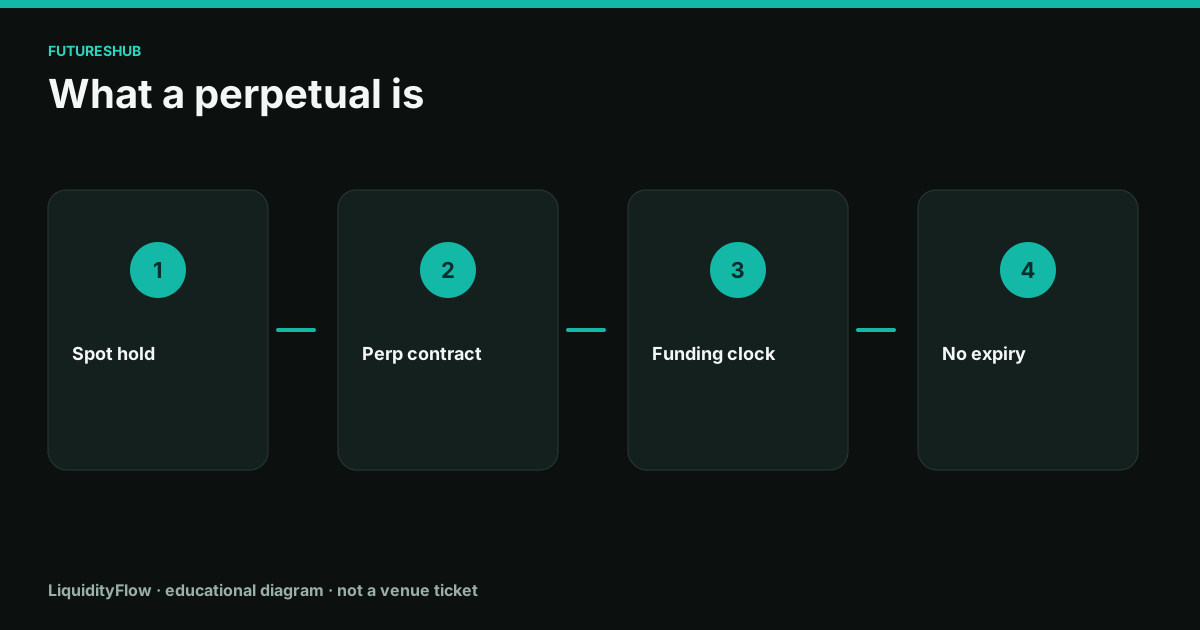
A perpetual is a futures contract with no delivery date. You post margin, you gain or lose as the contract price moves, and a funding payment between longs and shorts keeps the contract from drifting away from the spot market for long.
What you actually hold
A spot buy leaves you with the coin. A perpetual leaves you with a contract: an agreement to exchange the price change. On a linear USDT contract, that change is settled in USDT. You can close the position by trading out of it. There is no calendar day when the venue forces delivery of the coin.
The contract still needs a reference. Venues publish an index from spot markets, then a mark price built from that index. Your unrealized result and your liquidation check usually follow the mark. The last trade on the perpetual book can sit above or below that mark for a while.
Why funding exists
A dated future converges because expiry forces settlement to the spot price. A perpetual has no expiry, so the venue schedules a funding payment. When the perpetual trades rich to the index, the funding rate is usually positive and longs pay shorts. When it trades cheap, shorts usually pay longs. The payment is the substitute for expiry.
Funding is a cashflow between the two sides of the open interest. It is separate from the maker and taker fee you pay the venue for the trade itself. A position that looks flat on price can still lose money if you pay funding every interval while you hold it.
What changes the moment you use leverage
Leverage changes how much margin you must post for a given contract size. It does not change the price move. A 1% move on a $10,000 notional is about $100 of profit or loss at 2x and at 20x. At 20x you posted about $500 instead of $5,000, so the same $100 is a much larger share of the margin, and the liquidation price sits closer to the entry.
The practice desk and the tools workbook both use a sketch with maintenance assumed at 0.5%. That sketch shows the shape. The venue engine uses its own maintenance tiers, its own mark, and its own fees. Read the contract specification before you treat any desk number as the level on the ticket.
On the ticket
- Open the contract specification and write down three names: index, mark, and last. Note which one the ticket uses for liquidation and which one a stop can use.
- Write down the funding interval and the countdown. A position open at the timestamp pays or receives funding. A position closed before that timestamp usually does not.
- Pick the contract size in coin or in quote, then compute notional before you pick leverage. Leverage is the second decision.
- Compare the mark with the last price. If they disagree, the liquidation check and the tape are answering different questions.
Questions
Does a perpetual expire?
No. The position stays open until you close it, until it is liquidated, or until the venue closes the market. Funding is the mechanism that replaces expiry.
Is funding a fee paid to the exchange?
On the usual specification, funding is paid by one side of the market to the other. The trading fee is a separate charge for the fill. Read the contract if a venue takes a cut of funding.