


Liquidation Myth vs Rule on Bitunix: "100x on 500 USDT puts my whole account at risk"
Key takeaway
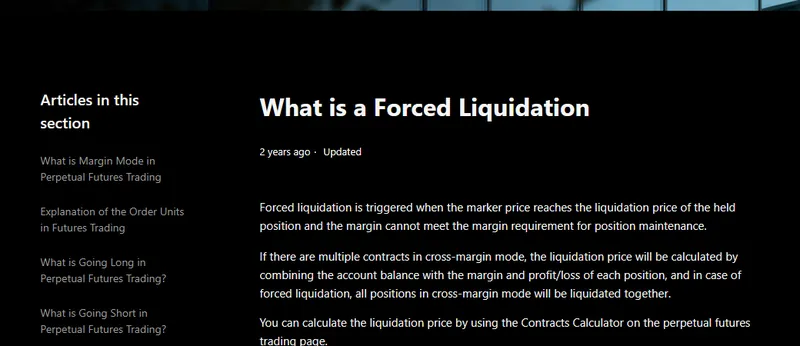
Third post in the Myth vs Rule series on liquidation, checking common beliefs against each exchange's own help-center pages. This one covers Bitunix, using its forced liquidation guide and its mark price page. The screenshot above is the public Bitunix help-center page "What is a Forced Liquidation", which says liquidation is triggered when the mark price reaches your liquidation price.
Myth 1: "If the last price touches my liquidation price, I am out."
Rule: Bitunix says forced liquidation is triggered when the mark price reaches the liquidation price of the position and the margin cannot meet the maintenance requirement. The mark price is not the last trade. Bitunix calculates it as the median of three inputs: two prices built from the index price (one using the funding basis, one using a 30-minute moving average of the order-book basis) and the latest price. Using a median means one odd print on its own does not set the mark.
Myth 2: "At 100x, a 1% move wipes me out."
Rule: It is closer than that. Bitunix's own isolated example uses 500 USDT of margin on BTC at 100x, which is a 50,000 USDT position. The maintenance margin rate for that setting in the example is 0.5%, so maintenance margin is 250 USDT. That means the position can only absorb 500 - 250 = 250 USDT of loss before liquidation, excluding fees and funding. On a 50,000 USDT position, 250 USDT is a 0.5% move. Not 1%. Half that.
Bitunix also notes the maintenance margin rate is tiered and the example rate is a standard setting, not a promise for extreme conditions. Bigger positions sit in higher tiers.
Myth 3: "Isolated or cross, it's the same risk."
Rule: Bitunix spells out the difference:
- Isolated: long and short risks are calculated separately. If the position is liquidated, only the margin allocated to that position is lost. In its example, the other 500 USDT in the account is not affected.
- Cross: all available funds in the futures account count as margin. That gives more room to absorb losses, but if you hold several cross positions the liquidation price is calculated from the account balance plus the margin and P/L of each one, and in a forced liquidation all cross positions are liquidated together.
So the myth in the title is half right. In isolated mode, 100x on 500 USDT puts that 500 USDT at risk. In cross mode it can put the whole cross balance, and every other cross position, at risk.
Myth 4: "A stop right next to the liquidation price is fine."
Rule: Bitunix's example recommends a stop loss above the liquidation price, so you exit on your terms rather than being force-closed and losing the margin. Give it real distance. Fees and funding are left out of the example, and both make the real liquidation level a little closer.
Myth 5: "I can't know my liquidation price until I am in the trade."
Rule: Bitunix points to the Contracts Calculator on the perpetual futures trading page. You can enter size, leverage and margin there before opening.
The rule to remember
On Bitunix, liquidation follows mark price (a median, not the last trade) against the maintenance margin. At high leverage the room is thinner than most people think: in Bitunix's own 100x example it is half a percent. Pick isolated if you want the loss capped at that position's margin, and size before you click.
Quick self-test before your next trade
- Have you run the size through the Contracts Calculator first?
- At your leverage, what percentage move takes you to maintenance margin?
- Is this position isolated, or is your whole cross balance behind it?
- Is your stop clearly above (for a long) or below (for a short) the liquidation price?
If any answer is "not sure", check before you click.
That wraps the first round of the series. Which venue should be next?
FAQ
How is the Bitunix mark price calculated?
As the median of two index-based prices and the latest price.
What do I lose in isolated liquidation on Bitunix?
Only the margin allocated to that position.
Are all cross positions liquidated together?
Yes, per the help center, all cross-margin positions are liquidated together.