
Zcash NU7 lands around Nov 5: blocks go from 75 to 25 seconds, but issuance is meant to stay flat.
What actually changes for ZEC holders and traders
Key takeaway
Zcash has a network upgrade coming up, and the price chart already shows traders paying attention. This is a good moment to separate what the NU7 upgrade actually changes from the stories that tend to get attached to it.
The verified basics
- Activation is set by block height, 3,543,405 on mainnet, expected around November 5, 2026. The date is an estimate from block progress, not a fixed clock time.
- Zebra 7.0.0 is the first stable node release that supports NU7 on mainnet.
- The target time between blocks drops from 75 seconds to 25 seconds.
- Reward per block is divided by three and halving intervals are adjusted, so the intended daily issuance stays the same.
- A new Network Sustainability Mechanism routes part of transaction fees toward future block subsidies.
Faster blocks, explained without the hype
Block spacing is an average, not a stopwatch. With a 25-second target, the expected wait for the next block is a third of what it was, but any single wait can still be a few seconds or much longer.
Do not assume deposits get three times faster everywhere. Exchanges and wallets require a set number of confirmations, and some may raise that number after the upgrade to keep the same security margin. If a service used to want a certain count of 75-second blocks, it might now ask for more 25-second blocks. The real experience depends on each service's settings, network load and software readiness.
Throughput is a separate question too. More blocks per hour creates more room, but actual capacity depends on block limits, transaction sizes and how well nodes propagate blocks. Judge NU7 on real performance after activation, not on dividing 75 by 25.
Why this is not triple inflation
A common mistake is reading three times more blocks as three times more coins. The design cuts the per-block reward to a third, so daily issuance is meant to stay level. A simple illustration with made-up numbers: 10 units every 75 seconds is 480 units an hour. 10/3 units every 25 seconds over 144 blocks is also 480 units an hour. Same supply, more frequent slices.
The halving schedule changes in block terms to keep the same real-world timing. Any model that plugs the old block-height formula into the new chain will get the dates wrong.
The fee mechanism is not a buyback
Sending part of fees to future block subsidies changes the incentive structure for miners over time. It is not a company buying back shares or a protocol buying and burning tokens on the open market. If on-chain activity is low, the fee pool is small and the effect is small. Treat it as a long-run security design, not a near-term price lever.
What to watch around activation
- Chain height passing 3,543,405 and normal block production afterward.
- Wallet, explorer and exchange notices on readiness, including any pause of ZEC deposits or withdrawals during the switch. Pauses around upgrades are routine.
- New confirmation requirements on the services you use.
- Early data on actual block times and orphaned or competing blocks.
Where the market stands
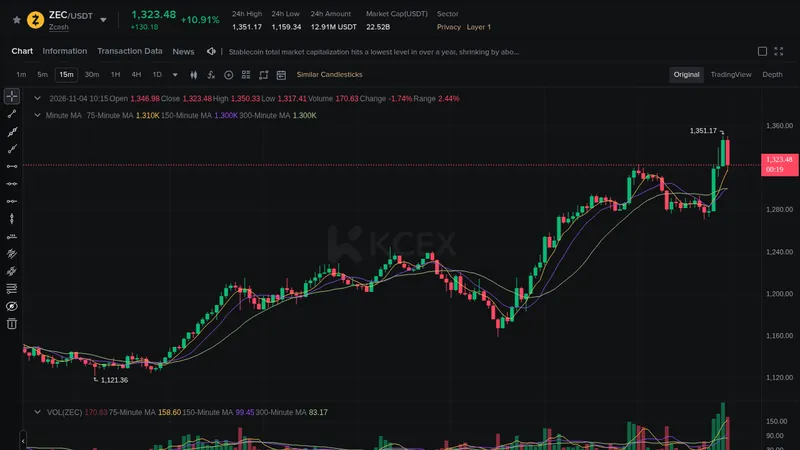
A live snapshot from the KCEX futures ticker at about 10:30 AM ET: ZEC near 1,323, up roughly 9.9% over 24 hours, after a range of about 1,158 to 1,351. Funding showed 0.01% for the current interval. For context, BTC traded near 80,554 and ETH near 2,438 at the same time, so ZEC was running well ahead of the majors. Other privacy-focused coins like XMR and DASH can move in sympathy on days when the theme is hot, but that link is loose.
The attached chart is a crop of the live ZEC/USDT screen taken at about the same time.
How to think about positioning
Upgrade weeks often bring a pattern traders call buy the rumor, sell the news: a run into the event and a fade once it passes. It does not always happen, and it is not a rule. What is reliable is that volatility tends to rise around hard-fork style events, and that deposit or withdrawal pauses can make moving coins between venues awkward for a few hours.
If you trade ZEC perps this week, size for wider swings than usual, keep leverage modest, and set stops that account for a move in either direction once the activation is confirmed.
NU7 is an engineering change first. If it activates cleanly and services update smoothly, that is the real win, and any price story should be built on that evidence rather than on the block-time math alone.
Open an account
KCEXKCEX fees, review and signup details
Open KCEXLiquidityFlow may earn a commission if you register through that link. Affiliate disclosure