
Holding a stock perp on Bitbase this month?
How cash dividend settlement works, who pays, and the 30-minute Reduce-Only window
Key takeaway
If you trade the TradFi stock perpetuals on Bitbase, a dividend date is not just a footnote for shareholders. A Bitbase help-center announcement dated Nov 3 lists seven stock contracts that settle a cash dividend in November, and the settlement moves real money between longs and shorts. Here is how it works, using only what the announcement says.
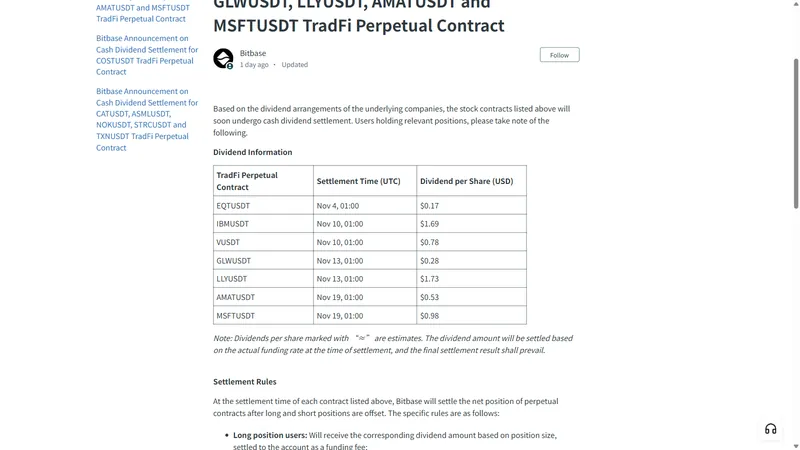
The screenshot above is the public Bitbase help-center page with the dividend table: contract, settlement time in UTC, and dividend per share in USD.
The November schedule on the page
- EQTUSDT: Nov 4, 01:00 UTC, $0.17 per share (already settled)
- IBMUSDT: Nov 10, 01:00 UTC, $1.69 per share
- VUSDT: Nov 10, 01:00 UTC, $0.78 per share
- GLWUSDT: Nov 13, 01:00 UTC, $0.28 per share
- LLYUSDT: Nov 13, 01:00 UTC, $1.73 per share
- AMATUSDT: Nov 19, 01:00 UTC, $0.53 per share
- MSFTUSDT: Nov 19, 01:00 UTC, $0.98 per share
01:00 UTC is 8:00 PM ET the evening before, so the IBM and Visa settlements land on the evening of Nov 9 in New York. That timing matters if you only check positions during US market hours.
The page also notes that any figure marked with an approximate sign is an estimate, and that the final settled amount is the one that counts.
Who receives and who pays
The rule is simple, and it mirrors what happens with real shares:
- Long positions receive the dividend amount, credited as a funding fee.
- Short positions pay the dividend amount, debited as a funding fee.
- No position, or a net position of zero, is not included.
Bitbase settles the net position after longs and shorts are offset. So if you somehow hold both directions on the same contract, only the net size counts.
The formula
Dividend amount = net position size x contract multiplier x dividend per share.
The contract multiplier is the piece people skip. Check the contract specification for the exact stock perp before you do the math, because the number of shares one contract represents is what turns the per-share dividend into your actual credit or debit. Do not assume one contract equals one share.
The 30-minute Reduce-Only window
Starting 30 minutes before each settlement time, the affected contract switches to Reduce-Only. During that window you can close or shrink a position, but you cannot open a new one or add to an existing one. After settlement, normal trading and the regular funding mechanism resume.
Practical effect: if you planned to open a long at 7:45 PM ET to catch the IBM dividend, you are too late. The window opens at 7:30 PM ET.
The part shorts should not ignore
The announcement includes a direct reminder for short holders: the dividend is deducted from your balance, and that deduction can change your margin ratio. If the position is already near its maintenance level, a funding debit at settlement can be the thing that tips it into liquidation. A $1.69 per-share debit sounds small until it is multiplied across a large position at high leverage.
Before a settlement date on a short:
- Find the contract multiplier and work out your expected debit.
- Check how much free margin you have after that debit.
- Decide whether to add margin, lower leverage, or close before the window.
If you do not want to take part
Close the position before the settlement time. The page says positions can still be closed normally during Reduce-Only, so you are not locked in. The resulting funding entry shows up in your account records right after settlement.
Common mistakes
- Reading the settlement time as ET. It is UTC.
- Treating the dividend as profit for a long. Stock prices often adjust around ex-dividend dates, so the credit is not free money.
- Forgetting the multiplier and getting the size of the debit wrong.
- Planning to open a position inside the last 30 minutes.
Quick checklist
- Which stock perp do I hold, and is it on the list?
- Settlement time converted to my timezone?
- Contract multiplier checked?
- Expected credit or debit calculated?
- Margin buffer still fine after a debit (shorts)?
Stock perps sit next to crypto majors on the same account, so this also affects anyone running a crypto book with one equity hedge in the same cross-margin pool.
New to stock perps? Read stock perpetual futures explained and what happens on dividend dates.