
MEXC futures: why funding payments can move your liquidation price even when the chart goes nowhere
Key takeaway
A lot of people treat funding as a small fee that shows up in the history tab and nothing more. On MEXC it is more than that, because the money comes out of (or goes into) the same margin that keeps your position open.
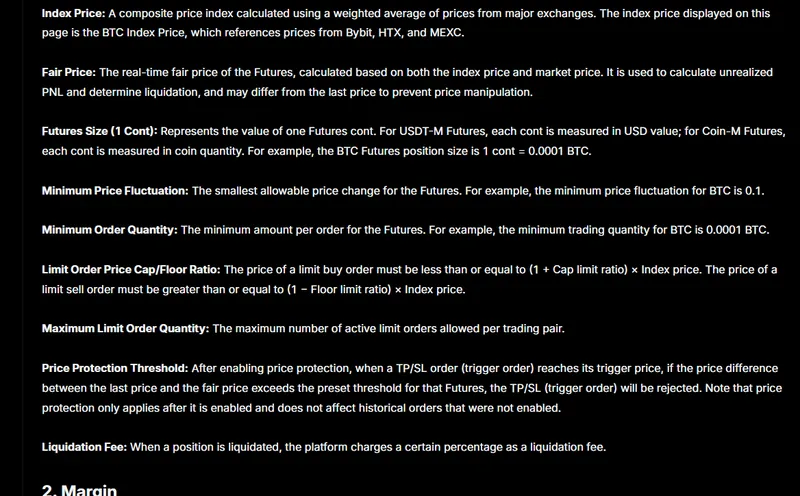
Here is what the official MEXC help pages say, and what it means for a position you plan to hold for a few days.
The screenshot above is the public MEXC futures terminology page, showing the definitions of Fair Price and the Price Protection Threshold.
The formula MEXC publishes
MEXC's funding rate page gives the fee as:
Funding Fee = Position Value x Funding Rate
The same page adds a line most people skip: funding fee deductions may affect your liquidation price and your final PNL. It also says settlement times vary by trading pair, so you need to check the schedule shown for the contract you actually hold rather than assuming one global time.
How big can one payment be?
That depends on the contract. MEXC's public contract details for BTC_USDT currently list a funding collection cycle of 8 hours, with the rate capped at 0.18% and floored at -0.18% per settlement. Other pairs can have different caps and shorter intervals, and MEXC regularly announces changes to settlement frequency on individual contracts. Read the contract details before you size anything.
Why this touches liquidation
Two definitions from the terminology page connect the dots:
- Fair Price is calculated from the index price and the market price. MEXC uses it to calculate unrealized PNL and to determine liquidation, and it can differ from the last traded price.
- Maintenance Margin is the minimum margin needed to keep a position. When your margin balance falls below it, the position is liquidated or reduced.
Put those together. If you are on the paying side of funding, every settlement takes a slice of your margin balance. The Fair Price may not have moved at all, but the cushion between your margin balance and the maintenance requirement is now smaller. Your liquidation price drifts closer to the current price. Stack several payments on a high-leverage position and that drift is no longer trivial.
On the receiving side the opposite happens: funding received adds to margin and pushes the liquidation price away a little. Neither side should plan around it, because the rate can flip sign between settlements.
What Price Protection does and does not do
The same terminology page describes the Price Protection Threshold. Once you enable it, if a TP/SL (trigger) order reaches its trigger price while the gap between last price and fair price is bigger than the threshold set for that contract, the TP/SL order is rejected. It only applies after you turn it on and does not change older orders placed without it.
That is a guard against stops firing on a distorted last price. It is not protection against funding slowly eating margin. Those are two different risks.
A practical checklist for multi-day holds
- Open the contract details and note the funding interval and the cap for that exact pair.
- Check which side is currently paying. A positive rate means longs pay shorts; a negative rate means shorts pay longs.
- Recheck your estimated liquidation price after each settlement instead of only when price moves.
- If you are paying funding at high leverage, keep extra margin in the position or reduce size before it becomes a problem.
- Use the Funding Fees records (Orders page on web, Capital Flow filter in the app) to see what you have actually paid.
- Remember that trading fees are separate from funding and vary by region and account, so check the fee page that applies to you.
The takeaway
Funding is not just a cost line. On MEXC it is deducted from margin, and margin is what stands between you and the maintenance requirement measured against Fair Price. If you hold through several settlements, treat each one as a small adjustment to your liquidation price and check it the same way you would after a price move.
How often do you actually check your liquidation price after a funding settlement?
FAQ
Who pays funding on MEXC?
With a positive rate longs pay shorts; with a negative rate shorts pay longs.
Which price does MEXC use for liquidation?
Fair Price, calculated from the index and market price, not the last traded price.
Are MEXC trading fees part of funding?
No. Trading fees are separate and vary by region and account.