
Bitbase risk tiers and funding, explained
why bigger positions carry more maintenance margin, how tier-1 partial liquidation works, and who pays funding
Key takeaway
Two things decide how much room a Bitbase perp position really has, and neither is on the leverage slider: the risk-limit tier the position sits in, and the funding you pay or collect while you hold it. Here's how both work, from Bitbase's own help center.
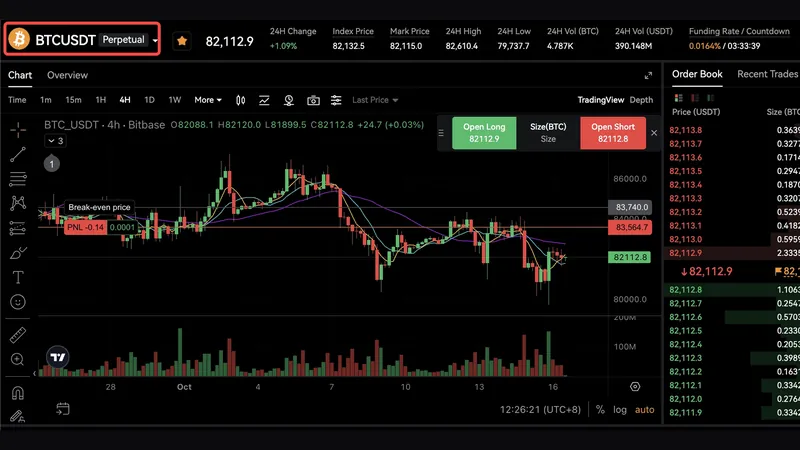
The image is from Bitbase's help-center guide: the BTCUSDT perpetual header with Index Price, Mark Price and the Funding Rate / Countdown (0.0164% in that capture) above the 4h chart.
Risk tiers in plain terms
- Maintenance margin = position notional × the maintenance margin rate for its tier (minus a tier deduction in Bitbase's formulas)
- Bigger positions sit in higher tiers. Your maintenance requirement depends on position value, tier, Mark Price, unrealized PnL and fees
- Tiers, position limits and leverage are set per contract and Bitbase can adjust them, including for open positions. Rules for one contract don't carry over to another, so check the risk-limit details on the trading page for the pair you trade
Where the tier really bites: the liquidation ladder
Bitbase watches the Maintenance Margin Ratio (maintenance requirement ÷ margin equity). At 100% it works through these steps in order:
- Cancel open orders that tie up margin, then recheck
- Net hedges: in Hedge Mode, offsetting long and short on the same contract are netted first
- Partial liquidation: a position in tier 2 or higher gets cut straight down to the tier-1 max size, then rechecked. If the ratio is back under 100%, the rest stays open
- Takeover: whatever's left goes to the Insurance Fund account at the bankruptcy price
It can skip straight to takeover if the ratio hits 160%, equity goes negative, or you're already in the lowest tier with nothing to cancel. In fast markets all four steps can happen before you can click anything. If the Insurance Fund runs dry, ADL kicks in and the most profitable, highest-leverage positions on the other side get reduced first.
Takeaway: sizing into a higher tier doesn't just raise your maintenance margin. It also decides how much of the position partial liquidation can save.
How funding works on Bitbase
- Funding is a recurring payment between longs and shorts on perps, settled at each contract's funding times
- It's based on your position's notional at settlement × the funding rate. Whether you pay or receive depends on your actual position at that moment
- A close order that hasn't filled yet doesn't get you out of settlement
- The estimated rate can change before settlement. The interval and timing are set per contract, so check the countdown on the pair
- Funding reduces your available balance and margin equity, so paying it can push your ratio toward 100%. It keeps accruing during maintenance and on TradFi perps when the market's closed
Worked example: at the 0.0164% shown in the screenshot, a 10,000 USDT position settles about 1.64 USDT that period. The side that pays depends on the sign of the rate at settlement.
Three checks before you size up
- Which tier does this size land in for this contract?
- What does a tier-1 cut leave you with?
- What's the funding rate and countdown, and which side of it are you on?
Open an account
BitbaseBitbase fees, review and signup details
Open BitbaseLiquidityFlow may earn a commission if you register through that link. Affiliate disclosure